


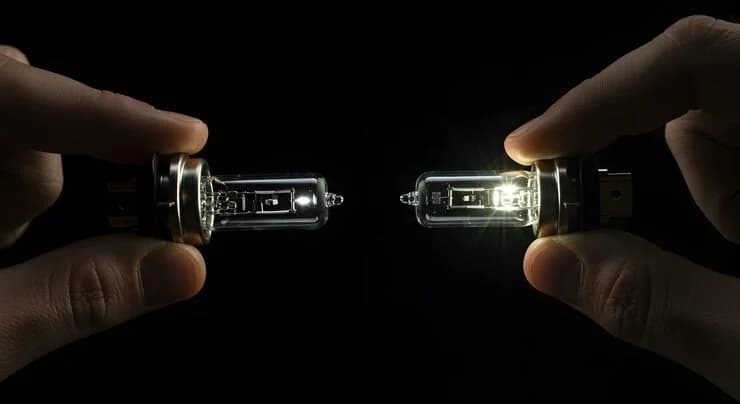
Selection of the correct headlights can entirely change how your automobile appears and performs on the street at night. At Motor and Mechanix, we mostly receive queries about led vs hid headlights and which choice really provides improved visibility, durability and worth. This blog breaks down the distinctions so you can make a knowledgeable choice for your automobile.
Understanding LED vs. HID Headlights
To figure out which is better led or hid, your initial requirement is to look at how they operate. LEDs (Light Emitting Diodes) rely on semiconductor chips that light up immediately when powered, providing highly focused illumination with less heat. Conversely, HIDs (High-Intensity Discharge) utilize an electric arc to fire xenon gas, throwing a brilliant, wide beam down the road. Both are big steps up from standard factory halogen bulbs, but the correct selection ultimately relies on your unique driving needs, budget and automobile type.
How do LED and HID Headlights Operate?
- LED headlights depend on diodes that change electrical energy directly into light, requiring no gas or filament
- HID headlights utilize a ballast to ignite xenon gas, developing an arc that glows brightly once warmed up
- LEDs light up immediately whereas HID bulbs might take a few seconds to reach full brightness
- LEDs create less heat while HID bulbs run hotter due to the ignition procedure
HID vs LED Brightness – Which Shines Brighter?
In case you’re comparing hid vs led brightness, the first thing to understand is that both will completely outshine classic halogens. HIDs, in particular, project an incredibly intense, bluish-white glow that spreads out wide, making them best for lighting up dark, expansive stretches of the street. LED headlights, meanwhile, provide a crisp, white light that’s highly focused and constant, with contemporary LEDs now matching or even exceeding HID brightness levels in lumens.
- HID bulbs normally range between 3000 – 4000 lumens
- High-quality LED bulbs can reach 4000 – 6000+ lumens
- LEDs keep continuous brightness across their lifecycle whereas HID bulbs may dim gradually as time goes by
Halogen vs LED vs HID – A Fast Comparison
To give you a clean image, below’s a side-by-side look at halogen vs led vs hid headlights throughout important performance factors:
| Feature | Halogen | LED | HID |
| Brightness | Low to medium | High | Very High |
| Lifecycle | 500 – 1,000 hours | 20,000 – 30,000 hours | 2,000 – 5,000 hours |
| Energy Effectiveness | Low | High | Moderate |
| Heat Emission | High | Low | High |
| Warm-up Time | Immediate | Immediate | 2 – 5 seconds |
| Expense | Low | Medium to High | Medium |
| Beam Consistency | Average | Excellent | Good |
This comparison represents why most of the riders are upgrading away from halogen bulbs and why the real debate today revolves around LED vs.HID instead of either against halogen.
LED Headlight Conversion – What You Need to Understand
In case your automobile still runs on halogen or HID bulbs, a led headlight conversion is one of the most famous enhancements among vehicle owners now-a-days. Converting to LED provides various functional advantages:
- Longer lifecycle – LEDs can last several years longer than halogen or HID bulbs, decreasing changing expenses
- Lower power consumption – LEDs require less energy, easing the load on your vehicle’s electrical system
- Better longevity – Solid-state diodes are more resistant to vibrations and shocks than gas-filled bulbs
- Immediate illumination – No warm-up delay, which enhances security during sudden nighttime driving requirements
Nonetheless, a conversion kit must be compatible with your vehicle’s headlight housing to prevent glare issues for ongoing traffic. It’s always best to take advice from an expert installer, similar to the team at Motor and Mechanix, to guarantee careful alignment and legal adherence.
Which is Better – LED or HID?
There’s no one answer to which is better led or hid, as it relies on your priorities:
Select LED in case you need:
- Longevity and lower upkeep
- Power effectiveness and instant brightness
- A contemporary, crisp white beam look
Select HID in case you need:
- Maximum brightness and wider beam spread
- A slightly lesser upfront expense compared to high-end LEDs
- Proven performance in older HID-compatible housings
For the majority of contemporary automobiles, LED headlights are highly cherished due to their durability, effectiveness and simple upkeep whereas HID continues to be a solid choice for those looking for maximum brightness on a budget.
Conclusion
Both LED and HID headlights provide great upgrades over halogen bulbs, but LEDs normally edge ahead in effectiveness, lifecycle and constant performance, making them the better long-lasting investment for the majority of riders. Whatever you select, Motor and Mechanix is here to assist you locate the correct headlight solution for your automobile.
FAQs
Which is brighter, LED or HID headlights?
Both are bright, but high-end LED headlights now mostly match or exceed HID brightness alongside maintaining more consistent output as time goes by.
Is LED headlight conversion lawful for all automobiles?
Whether you can lawfully make the switch depends on your location and if the conversion kit actually fits your headlight housing. Just make sure to re-validate your regional laws before you start proceeding with any installation.
How long do LED headlights last in comparison to HID?
LED headlights normally last 20,000 – 30,000 hours, significantly longer than HID bulbs, which average 2,000 – 5,000 hours.
Do HID headlights utilize more power than LED?
Yes, HID headlights normally use more power due to the ballast and ignition procedure whereas LEDs are more energy-effective.
Should I modify from halogen directly to LED or HID?
The majority of professionals suggest modifying directly to LED for better effectiveness, longevity and long-term worth, unless your automobile specifically needs an HID setup.